

Here's a conversation we've had with a lot of manufacturers lately. A marketing director pulls up their analytics, looks at a year of organic traffic, and says some version of: We're doing everything right. Why does this feel harder?
The content is good. The site is technically sound. Rankings haven't collapsed. And traffic is down anyway.
The uncomfortable answer is that nothing is wrong with the work. What changed is the destination. Contractors, specifiers, designers, and homeowners are still researching exactly as much as they used to — they're just resolving more of that research before they ever reach a website.
The zero-click reality, in numbers
This is measurable, and the measurements are not subtle.
Pew Research Center tracked the actual browsing behavior of 900 U.S. adults across nearly 69,000 Google searches. When users encountered an AI summary, only 8% clicked through to a website — compared to 15% for users who saw only standard search results, roughly half as often. Clicks on the sources cited inside the AI summary were rarer still, at about 1% of visits.
This shift in search behavior goes further than a single click. Users were much more likely to end their browsing session entirely after landing on a search page with an AI summary. That’s what happens 26% of the time, versus 16% on traditional results pages. The research didn't move the user to a competitor's site. It simply concluded.
And the surface area keeps expanding. Roughly 18% of Google searches in that study period produced an AI summary, and 88% of those summaries cited three or more sources. (Search Engine Land's coverage is a good short summary if you want to send this to a colleague.)
Reader behavior has moved just as fast. Pew's Americans and AI 2026 survey, fielded in February 2026, found that 60% of U.S. adults now say they read the AI summary at the top of search results. About half use AI chatbots at all — up from a third in 2024 — and roughly a quarter use them daily. ChatGPT adoption reached 44% of U.S. adults, up from 18% in 2023.
Most telling for anyone in marketing: searching for information is the single most common thing people use chatbots for, ahead of work tasks, entertainment, and everything else.
This is not an experiment anymore. It's the front end of your category's buying journey.
Longer questions are changing everything
There's a second shift in behavior underneath the click data, and it's the one that truly determines strategy.
People ask AI tools fundamentally different questions than they type into a search box.
Semrush's analysis found the average Google query runs about four words, Google's AI Mode about seven, and the average ChatGPT prompt around 23. That makes the AI result long enough to carry context, constraints, and intent.
Think about what that means in practice. The old path: a contractor spec'ing a mixing valve for a multi-family retrofit runs four separate searches, opens a dozen tabs, cross-references three spec sheets, and assembles a conclusion themselves. Fifteen or twenty minutes of work.
The new path: they ask one detailed question — the building type, the code requirement, the budget, the timeline — and the AI runs those searches behind the scenes, reads the pages, synthesizes what it finds, and returns a confident recommendation. Ten seconds.
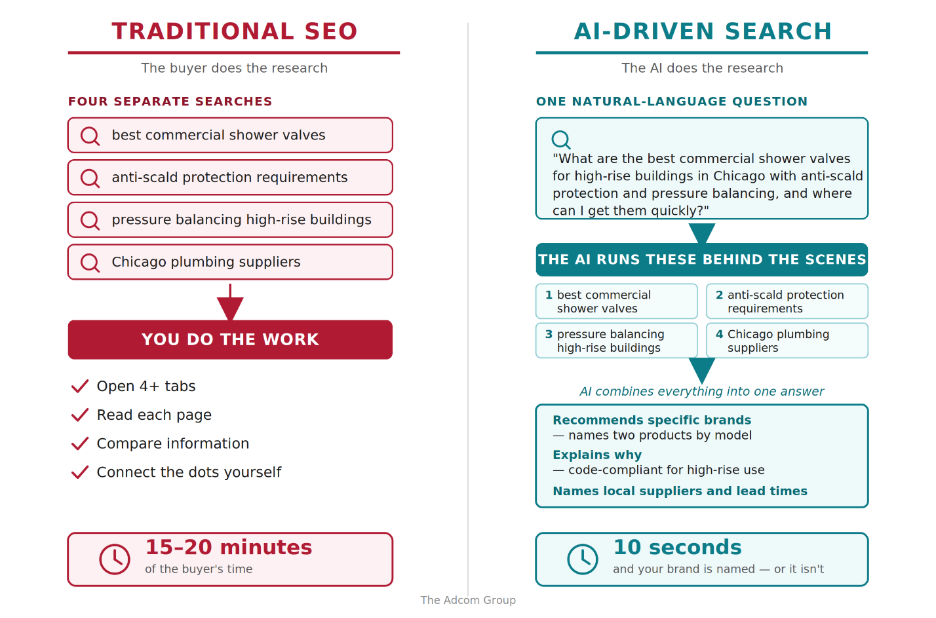
That "behind the scenes" part is literal, and it's been measured. A study of 8,500+ prompts by Nectiv found ChatGPT runs a web search on about 31% of prompts, and when it does, it averages more than two searches per prompt — a behavior called query fan-out. Those internal queries average 5.48 words, roughly 60% longer than a typical Google search, and they skew toward exactly the terms your buyers use: comparisons, reviews, features, the current year.
The research labor that used to fall on your customer now falls on a model. And that model is deciding which brands belong in the answer before your website enters the picture.
So the strategic question is no longer "how do we rank?" It's: when AI explains our category, are we part of the explanation?
Modern SEO = SEO + AEO + GEO
The discipline hasn't been replaced. It's been extended. Three things now happen at once:
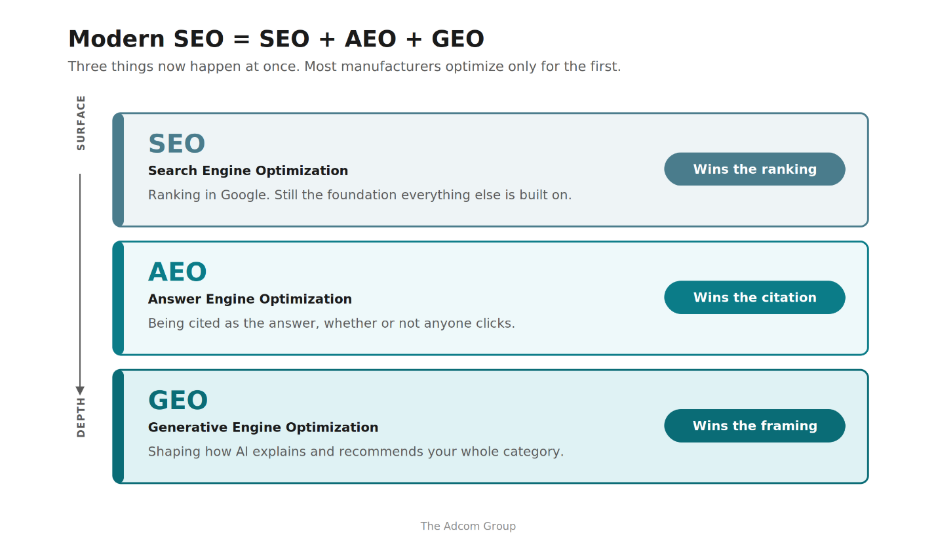
SEO — Search Engine Optimization. Ranking in Google. Still real, still valuable, still the foundation everything else is built on. Organic search remains a major traffic driver; it just no longer converts visibility into clicks at the old rate.
AEO — Answer Engine Optimization. Being cited as the answer, whether or not anyone clicks. This is visibility without a session. It shows up in brand recall and RFP shortlists long before it shows up in analytics.
GEO — Generative Engine Optimization. Shaping how AI explains and recommends your category. This is the deepest of the three. It's not about being retrieved — it's about being the frame through which the model understands the problem your product solves.
Most manufacturers are still optimizing exclusively for the first one.
What AI rewards: teaching, not selling
Here's the shift in mindset that matters most, and it's genuinely uncomfortable for a lot of product marketing teams.
AI doesn't rank links. It evaluates understanding.
It doesn't promote brands, it promotes explanations. When it needs to explain something in your category, it reaches for the clearest, most authoritative, most complete explanation available. If that explanation happens to be yours, you get named. If it isn't, you don't.
Which leads to three principles worth putting on a wall:
- Clarity beats cleverness. Campaign language doesn't survive synthesis. Plain, specific explanation does.
- Teaching beats selling. Promotional copy is discounted. Educational content is quoted.
- Understanding beats documentation. A PDF cut sheet full of specifications is not an explanation. Models struggle to extract meaning from it, and buyers were never going to read it anyway.
Consider the difference concretely. A manufacturer develops a genuinely better pressure-balancing valve. The instinct is to publish the spec sheet — the flow rates, the certifications, the compliance table. That's real innovation, but it isn't legible. Nothing in it explains why a facilities manager at a multi-family property should care.
Now publish instead: how scalding incidents actually happen in multi-family buildings. How pressure balance protects occupants. What failure looks like on a jobsite, and what it costs. Same underlying innovation, framed as understanding rather than documentation.
The second version is what gets cited. It's also, not coincidentally, what an actual buyer wanted to read.
The same logic runs through every category in home and construction. Not "quartz countertop features and benefits," but why quartz outperforms marble in high-traffic kitchens. Not a finish durability chart, but the countertop choices designers say they regret.
Specs answer questions. Thought leadership defines them. AI prioritizes the second.
Where to start
You don't need to rebuild your content operation this quarter. A few moves carry most of the weight:
Stop chasing keywords. Start owning questions. Build content around the questions your buyers actually ask, in the language they actually use. Keyword density is not a ranking signal in an answer engine — clear, comprehensive answers are.
Add FAQs to everything. Search engines and LLMs both surface snippets, not pages. Question-and-answer structure is the single most extractable format there is, and schema markup makes it explicit.
Treat freshness as a requirement. AI systems favor recent, maintained content. Updating a strong existing post is cheaper than writing a new one and often outperforms it.
Keep site structure simple. Clear headings, clean URLs, obvious navigation. If a human can't find it, neither can a crawler or a model.
Take brand mentions seriously. In AI search, unlinked mentions across trade publications, forums, reviews, and industry conversation function much the way backlinks did in classic SEO. Presence across the web is the signal.
Pick a niche you can genuinely win. Broad category authority is expensive and slow. Depth in one defensible territory compounds, and the domain authority you build there lifts everything else you publish. We walked one manufacturer through exactly this, narrowing from a category they were losing by 8,000 keywords to a sub-category they were losing by 30.
About the author:
Anne Polkinghorn is the VP of Integrated Marketing at Adcom. With 25 years of experience in digital and e-commerce strategy, she helps clients modernize their marketing through smarter channels, like email, and emerging tools like AI.